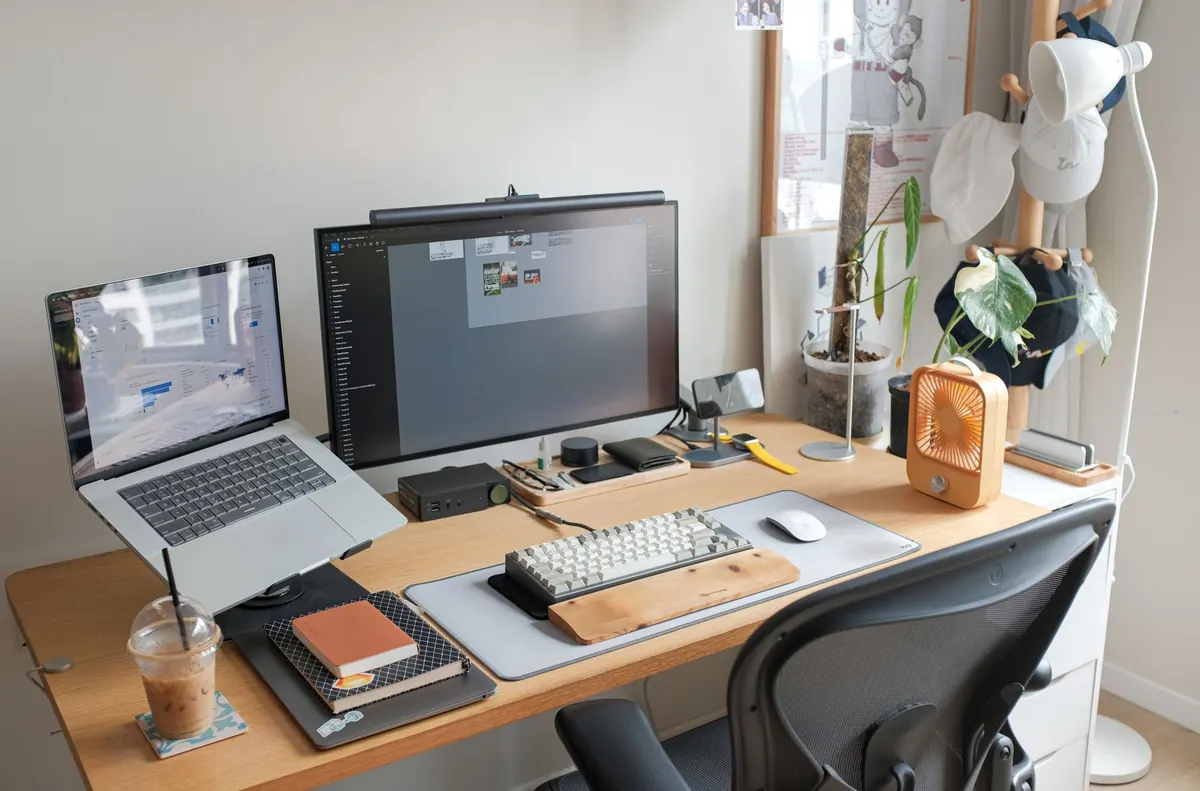
How to Set Up a Home Office in a Small Flat: A Step-by-Step Guide

Most British flats were not designed with a desk in mind. You have a bay window, a radiator you cannot block, and a bedroom that has to double as an office. The good news is that a workable home office in a small flat rarely comes down to square footage. It comes down to measuring properly, choosing furniture that genuinely fits, and then going upwards rather than outwards.
Here is how to do it in order, from the first measurement to the final cable tidy.
1. Measure the space before you look at anything
Resist the urge to browse desks first. Measurements come before shopping, or you will fall for something that is five centimetres too wide.
Measure the width of your intended wall at floor level and at desk height, because skirting boards and dado rails eat into usable space. Measure the depth from the wall to the nearest obstruction, whether that is a bed, a door swing or a radiator. Then measure the height clearance if you plan to work under a window, since sill height often rules out a standard 75cm desk with a monitor on top.
Write the numbers down and subtract a little breathing room. A desk that touches both walls feels cramped and is impossible to move once assembled.
Things people forget to measure
- Radiator positions and how far they protrude
- Door swing arcs, including wardrobe doors
- Plug socket locations and cable reach
- Window sill height if the desk goes under a window
- The diagonal depth of a chair when pulled out
That last one catches people out constantly. Your chair needs roughly 60cm behind it to slide back comfortably, so a 60cm deep desk really occupies closer to 120cm of floor.
2. Choose the right spot, not just the right desk
A corner is usually the most efficient place in a flat, since it wastes the least circulation space. But a corner desk with a deep sweep can block a doorway more than a straight desk against a wall. Be honest about how you actually use the room.
If you are working from a bedroom, try to position the desk so you are not facing the bed. It sounds fussy, but looking at an unmade duvet all day does wear you down. Facing a wall with a pinboard, a small shelf and a lamp is often better.
Light matters too. Side lighting from a window is kinder on a screen than sitting with your back to it or staring straight into it. If the only option is facing a window, a simple blind or a monitor hood makes a real difference.
3. Pick a compact desk that suits the work
For most people in a flat, the sweet spot is a desk around 100–120cm wide and 50–60cm deep. That holds a laptop, a monitor, a keyboard and a mug without feeling like a boardroom table.
Consider these options depending on your room:
- Wall-mounted desk: no legs, no floor footprint. Ideal in a narrow alcove, but you need solid walls and a stud finder.
- Folding or drop-leaf desk: closes to almost nothing. Good if the room must reset each evening.
- Ladder desk: slim with built-in shelving above. Great for laptops, less so for dual monitors.
- Small corner desk: uses dead space well, though it can dominate a small room visually.
- Console or hallway table: often 35–40cm deep. Workable for a laptop and not much else.
Check the weight rating if you use monitor arms or a heavy monitor. A wall-mounted desk or a thin-legged design may not take the load, and a sagging desk is not something you can fix later.
A note on depth
Depth is the measurement that decides comfort. If you wear glasses and sit close to a screen, 45cm can work. If you use a large monitor, aim for 60cm so your eyes are not straining at the edge of the panel. If space only allows 40cm, a wall-mounted monitor bracket frees up the desktop completely and makes a shallow desk far more usable.
4. Go vertical for storage
When the floor is full, the walls are not. Vertical storage is the single biggest space gain in a small flat office, and it keeps the desk surface clearer, which helps you focus.
Start with a wall shelf above the desk, positioned high enough to clear your monitor but low enough to reach. Two shelves 30cm apart give you room for books, folders and a plant without crowding your eyeline. Add a small rail or pegboard for headphones, cables and stationery, so they stop migrating across the desk.
If you rent and cannot drill, over-door organisers, freestanding shelf units that slot beside a wardrobe, and slim trolleys on castors all work. A three-tier trolley is quietly brilliant in a small flat: it holds printer paper, chargers and files, and rolls out of the way when you finish for the day.
Keep the top clear
Items stored above eye level should be things you rarely need. The zone around your screen should hold only what you use daily. Anything you touch once a month belongs higher or in a cupboard.
5. Sort lighting, power and cables
A single ceiling light gives you a shadow over your keyboard and glare on your screen. A small adjustable desk lamp positioned to the side of your monitor, rather than in front of it, solves most of this. If you take video calls, a light behind the screen or off to one side is more flattering than overhead lighting.
Power is the quiet killer of small setups. Check how many sockets you have before you commit to a layout, and use a surge-protected extension lead with a flat plug so furniture can sit flush to the wall. Route cables along the back of the desk with adhesive clips, and bundle the slack into a single loop. A small cable box hides the worst of it.
6. Make it easy to switch off
In a flat, your office is always in view. That is the real challenge, not the size. Build in a closing routine: put the laptop in a drawer, drop papers into a document box, and turn the desk lamp off. If your desk folds, fold it. If you have a trolley, wheel it beside the wardrobe.
The aim is that the room looks like a living space again by the time you stop working. That separation helps far more than any productivity trick.
Final thoughts
Start with the tape measure, not the website. A desk that fits your wall with room to spare, a shelf above it, and a sensible place to put everything at the end of the day will do more for your working life in a small flat than any amount of extra furniture. Buy the one piece that fits properly, then add storage only when you know exactly what it is for.
If you are making changes to a rented property, check your tenancy agreement before drilling into walls, and seek advice from your landlord or letting agent if anything is unclear.
Photo: mozlase__ / Pixabay