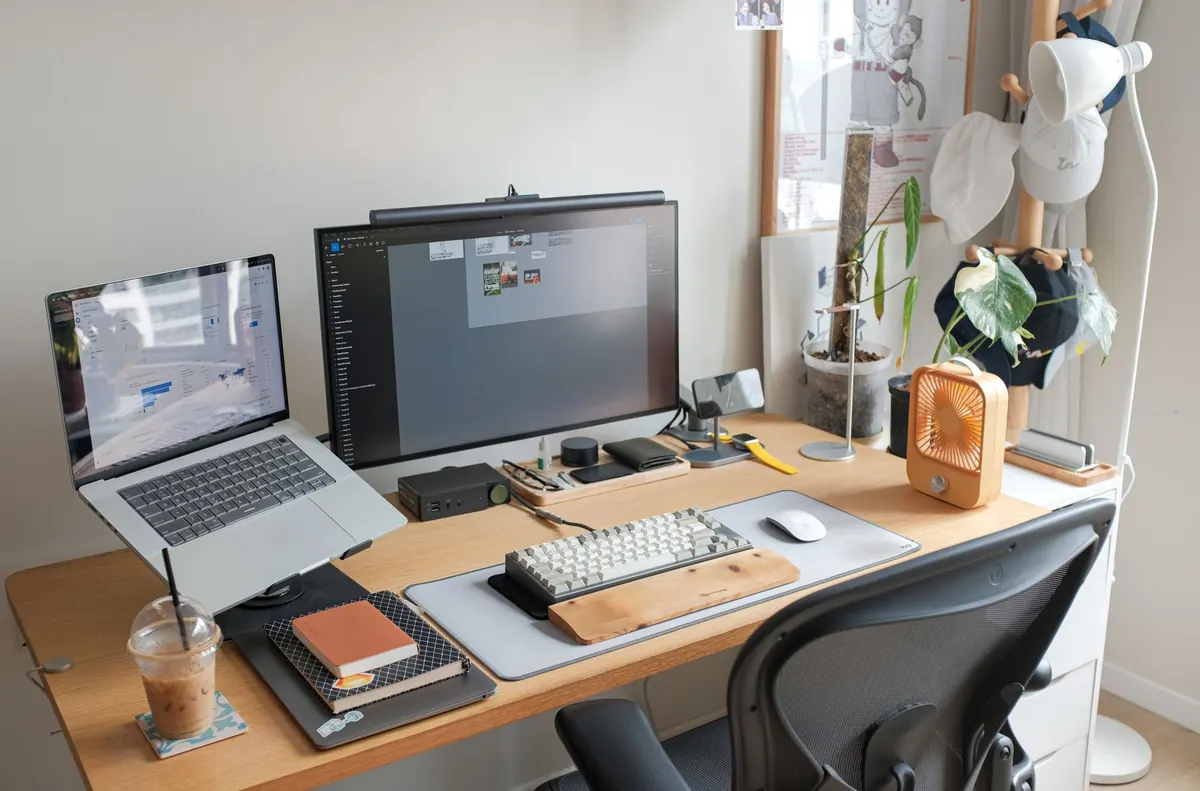
12 Home Office Organisation Ideas for a Clutter-Free Desk

A clear desk is rarely the result of willpower. It is the result of a few small systems that take less effort to keep than the mess takes to ignore. If your home office is a corner of the bedroom, the end of the kitchen table or a box room barely wider than the door, you have less room for error than someone with a dedicated study — and more to gain from getting the basics right.
These twelve ideas cover the whole loop: what sits on the surface, where everything else lives, how the cables behave, and what happens to paperwork when it arrives.
Start with the surface, not the shelves
Take everything off the desk. Everything. Wipe it down, then put back only what you have touched in the past week. Most of us work around a small museum of objects we have stopped noticing: a dead highlighter, three chargers for devices we no longer own, a stack of post that has quietly become furniture.
Once the surface is bare, divide it into three zones.
- Working zone: the space directly in front of you — keyboard, mouse, notebook, mug. Nothing else.
- Landing zone: one square of desk, usually on your weaker hand's side, for post, notes and whatever you carried in from the kitchen.
- Storage zone: a drawer, shelf or lidded box within reach but not under your elbow.
The rule that does most of the work is this: the working zone holds only what you are using right now. Everything else belongs in the landing zone or the storage zone, and the landing zone gets cleared at the end of each day.
Keep one A4 in-tray rather than a scatter of piles. A tray has edges, so you can see when it is fuller than usual — that is your cue to sort it, not to buy a second tray.
Choose storage that suits a small room
When floor space is scarce, go up. A shelf or wall rail at roughly arm's reach above the desk can hold the printer, the reference books you actually open and a couple of boxes, while keeping the desk itself clear. Wall-mounted storage frees more usable space than another piece of furniture, and it is easier to keep tidy because you see it every day.
Inside drawers, give each one a single category and label it: one for stationery, one for cables and small tech, one for personal paperwork. Sort first, then buy containers to fit what you have. It is far too easy to spend an afternoon buying matching boxes and end up with the same clutter, only tidier.
A lidded project box earns its space. When a piece of work is half finished and you need the desk for something else, everything goes in the box, the lid goes on, and the box goes on the shelf. The desk clears in seconds and the work resumes exactly where you left it. That one habit prevents more pile-ups than any filing system.
Tame the cables once and leave them alone
Cabling is the job people put off because it feels fiddly. Do it properly once and you will not think about it again for a year.
- Unplug everything and lay the cables out flat so you can see what you have.
- Group them by device and fasten each group with a reusable hook-and-loop tie. Skip single-use zip ties; you will want to undo them.
- Label both ends with a strip of masking tape and a marker. Ten seconds now saves twenty minutes later.
- Keep only the cables you use. Spares go in a labelled box, not loose in a drawer.
- Mount the power strip on the underside or back edge of the desk, so it sits out of sight and off the floor.
- Run cables along the back of the desk with adhesive clips, leaving a small loop of slack at each device so nothing strains the port.
- Keep leads out of walkways and away from chair castors, and check that nothing underfoot is pinched, kinked or warm.
Chargers are the usual culprits. If a cable lives permanently on the desk, it can stay; if it appears once a fortnight, it belongs in the box. If you need extra sockets or wiring moved, bring in a qualified electrician rather than adding another extension lead.
Give paperwork a route
Paper only piles up when it has no next step. Every sheet that lands on the desk should have one of three destinations, and it should reach one of them within a week.
- Act: it needs a reply, a payment or a phone call. It goes in the in-tray and stays there until it is done.
- File: it needs keeping. A lever-arch file or a few labelled folders, sorted monthly, is enough for most households.
- Recycle or shred: it needs neither. Deal with it there and then, or drop it in a shredding box you empty on the first of the month.
Fifteen minutes on a Friday afternoon will clear the tray and empty the shredding box. Treat digital clutter the same way: scan what matters, then name the file with the date first and a plain description, so it sorts itself. If you are unsure how long to keep receipts or records for tax, ask an accountant — the rules vary and it is worth getting right.
Reset the desk at the end of the day
Five minutes is enough. Take the cups to the kitchen, put pens back in the pot, close the notebook, straighten the in-tray, set the project box on the shelf and push the chair in. The next morning you sit down to a desk that is ready, rather than one that needs clearing before you can begin.
Once a week, add ten minutes: empty the shredding box, return stray items to their homes, wipe the screen, and look at the drawer where homeless things collect. One small box of odds and ends is fine. Two means something needs a proper place, or needs to leave.
Making it stick
A tidy desk is not the aim. A desk you can start work at without moving anything is.
Systems that demand perfect discipline will fail in a busy week, so build ones that forgive you. If the in-tray has not been emptied in three weeks, the tray is the problem, not your character — make the Friday sort shorter and more specific. If something has survived two monthly reviews in the homeless box, you almost certainly do not need it.
Start with the surface today, because it takes fifteen minutes and you will feel the difference straight away. Save the cables for a weekend when you have an hour and a mug of tea. Then let the routines carry the rest. A small workspace stays calm when everything in it has a home and a next step — and that is all organisation really is.
Photo: kaboompics / Pixabay